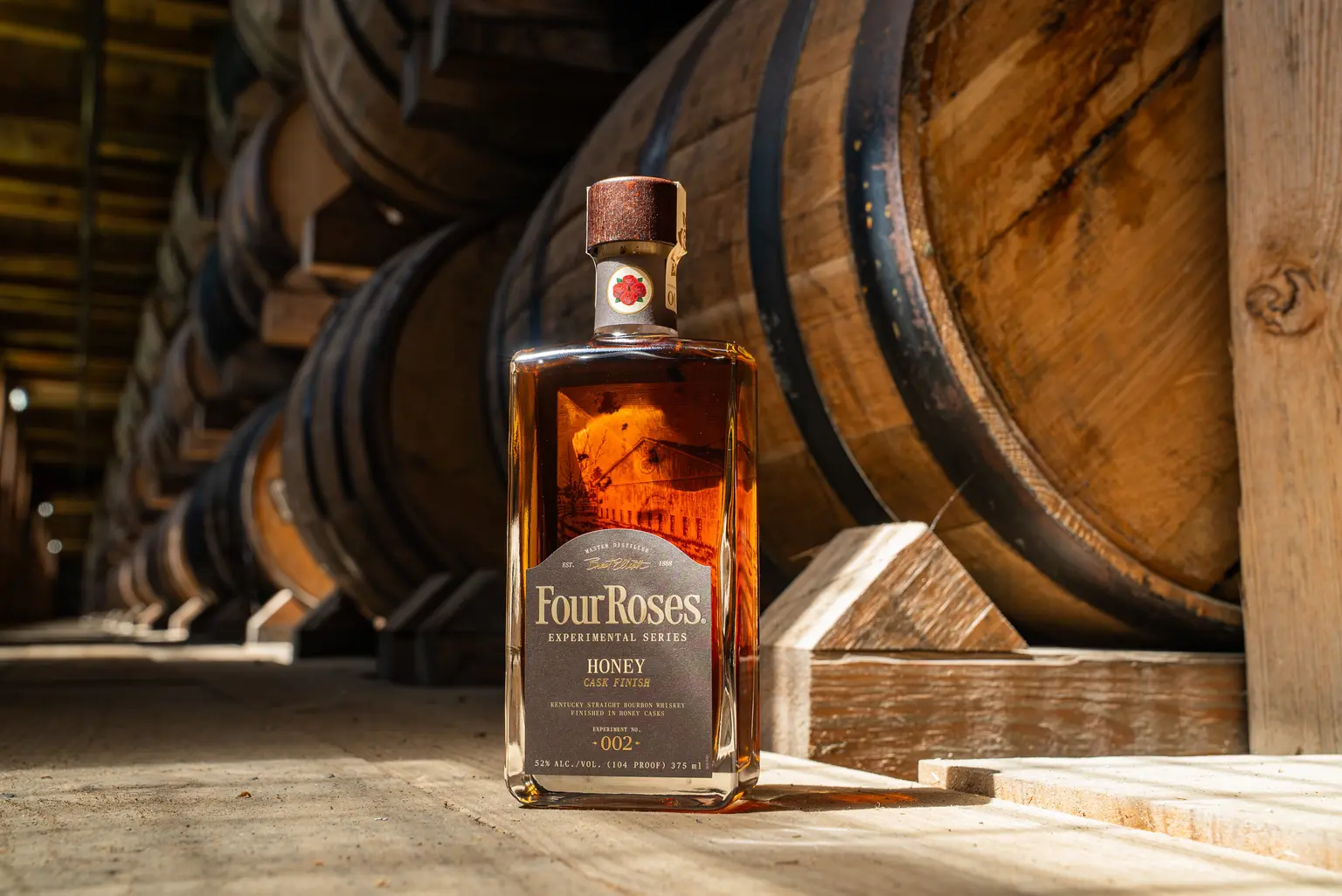
Four Roses Experimental Series No. 002 Honey Cask Finish is the second release in the Kentucky distillery’s experimental line, and despite the name, no honey is added. It is a Kentucky straight bourbon blending the OESQ and OBSK recipes, aged six to eight years, then finished for three to nine months in casks that previously held Four Roses Bourbon Barrel Aged Honey. Bottled at 104 proof (52% ABV) in 375ml, it carries stated notes of natural honey, floral character and warm baking spice. It launches 18 September 2026, distillery-exclusive in Kentucky, at $55.
Say “honey whiskey” and most people picture a bottle with honey poured in: sweet, syrupy, closer to a liqueur than a bourbon. Four Roses Experimental Series No. 002 does the opposite. Not a drop of honey goes into this whiskey. The sweetness, if it lands the way the distillery says it does, comes entirely from the wood.
This is the second release in the Kentucky distillery’s Experimental Series, following No. 001 Mizunara Cask Finish earlier in 2026. It is a Kentucky straight bourbon finished in casks that had already lived two lives before this one. The bourbon goes in at 104 proof and 375ml, and it lands on 18 September 2026.
What Experimental No. 002 actually is
The headline number is the cask. Four Roses filled these barrels with bourbon, emptied them, then handed them to Kentucky’s Bohman Bee Company to age the distillery’s own Bourbon Barrel Aged Honey. Once the honey was drawn off, the barrels came back to Lawrenceburg for a second fill of bourbon. That is the “unexpected journey” the brand keeps referring to: bourbon, then honey, then bourbon again, in the same wood.
The liquid inside is a blend of two of Four Roses’ ten recipes, OESQ and OBSK, aged six, seven and eight years, then finished in the honey-seasoned casks for three to nine months. Master Distiller Brent Elliott bottled it at 104 proof (52% ABV).
For readers outside the bourbon world, those four-letter codes are worth a second. Four Roses builds everything from two mashbills and five yeast strains, giving ten recipes. The second letter is the mashbill, the fourth is the yeast. OESQ uses the lower-rye mashbill (75% corn, 20% rye, 5% malted barley) with the “Q” yeast, prized for floral, delicate character. OBSK uses the higher-rye mashbill (60% corn, 35% rye, 5% malted barley) with the “K” yeast, known for baking spice.
Read that against the flavour profile Four Roses is promising, floral honey sweetness and warm spice, and the recipe selection makes sense. The floral Q recipe carries the honey and blossom side; the spicy high-rye K recipe brings the warmth. It is a deliberate pairing, not a random blend.
Why the honey cask matters
Cask finishing bourbon is not new, but finishing it in a barrel that previously held your own honey is unusual. Most finishes reach for wine, sherry, port or rum casks. Four Roses had a closed loop sitting in its own warehouse: the barrels that made its Bourbon Barrel Aged Honey were already carrying honey residue and whatever the honey drew out of the wood on the way in.
Elliott’s own framing is that the honey note “is there from the moment you bring the glass to your nose, but it’s never artificial or overpowering,” and he suggests tasting it side by side with the Bourbon Barrel Aged Honey to follow the barrel’s full arc. That side-by-side is the pitch here: this is a bourbon-first release that happens to carry honey, not a honey product wearing a bourbon label.
Four Roses Honey Cask Finish: stated tasting notes
We have not tasted Experimental No. 002 yet, as it launches on 18 September. The profile below is Four Roses’ own description. We will update this piece with independent notes once we get a pour.
Four Roses Experimental No. 002 Honey Cask Finish, stated profile
Nose: Natural honey, floral undertones
Palate: Honey sweetness, orchard fruit, warm baking spice
Finish: Rich and lingering, gentle heat from the proof
ABV: 52% (104 proof) | Cask: Ex-Four Roses Bourbon Barrel Aged Honey casks | Age: 6 to 8 years | Size: 375ml | Price: $55

Who makes it: a quick note on Four Roses
Four Roses distills in Lawrenceburg, Kentucky, and has built its reputation on the ten-recipe system rather than a single house pour. That approach, two mashbills crossed with five proprietary yeast strains, gives Elliott a wide palette to blend from, and it is the reason the distillery’s limited and experimental releases can shift character so much from one bottling to the next while still reading as Four Roses.
The Experimental Series is the newest strand of that story. No. 001 explored Japanese Mizunara oak. No. 002 is the honey cask. No. 003 has been teased but not detailed, and the distillery has signalled that future releases will move beyond cask finishing into other kinds of experimentation.
Price and availability
Price: $55 (SRP) Size: 375ml Release date: 18 September 2026 Where: Four Roses Distillery and the Cox’s Creek Visitor Center, Kentucky, distillery-exclusive at launch
This is where international readers need to set expectations. At launch, No. 002 is sold only at the two Kentucky sites, and it is a small 375ml bottle. At $55 for a half-size bottle, you are paying the equivalent of roughly $110 for a standard 750ml, before any secondary-market premium. Expect bottles to surface at secondary retailers shortly after release, almost certainly above SRP. There is no announced European or international distribution, so anyone outside the US will likely be buying through the secondary market or a specialist importer.
Is it worth chasing?
Two honest caveats first: it is unreleased, and it is distillery-exclusive in small format at a price that works out high per millilitre. If you are buying purely on liquid-per-dollar, a full-size bottle of Small Batch Select or a Four Roses single-barrel store pick gives you more bourbon for the money.
What you are actually buying with No. 002 is the idea and the rarity. The barrel journey is genuinely novel, the recipe selection is thoughtful, and the Experimental Series is shaping up to be the most interesting thing Four Roses has done in years. For the collector who already keeps Four Roses limiteds on the shelf, or for anyone who wants to taste it against the Bourbon Barrel Aged Honey as Elliott intends, this is an easy yes. For the drinker who just wants a good everyday bourbon, the core range is the smarter spend.
We will report back with full tasting notes and a verdict once No. 002 is in the glass.
Frequently asked questions
What is Four Roses Experimental Series No. 002 Honey Cask Finish? It is the second release in Four Roses’ Experimental Series: a Kentucky straight bourbon finished in casks that previously held the distillery’s own Bourbon Barrel Aged Honey. No honey is added to the whiskey. It blends the OESQ and OBSK recipes, aged six to eight years, bottled at 104 proof.
Does Four Roses Honey Cask Finish contain added honey? No. Unlike honey-flavoured whiskey liqueurs, no honey is added to the liquid. The honey character comes only from the barrels, which were used to age Four Roses Bourbon Barrel Aged Honey before being refilled with bourbon for three to nine months of finishing.
What does Four Roses Honey Cask Finish taste like? Per Four Roses, the profile leans on natural honey sweetness and floral undertones on the nose, orchard fruit and warm baking spice on the palate, and a rich, lingering finish. Independent tasting notes will follow after the 18 September launch, as the whiskey is not yet on sale.
How much does Four Roses Honey Cask Finish cost? The suggested retail price is $55 for a 375ml bottle. That works out to roughly $110 for a 750ml equivalent. Expect prices above SRP on the secondary market, especially outside the US where there is no official distribution.
Where can I buy Four Roses Experimental No. 002? At launch it is exclusive to the Four Roses Distillery and the Cox’s Creek Visitor Center in Kentucky, from 18 September 2026. Bottles are expected to appear at secondary retailers soon after. There is no announced European or international release.
What is Four Roses known for? Four Roses is a Lawrenceburg, Kentucky distillery built on a ten-recipe system: two mashbills crossed with five proprietary yeast strains. That gives Master Distiller Brent Elliott an unusually wide range to blend from, and underpins the distillery’s core range plus its limited and experimental bottlings.
Leave a Reply