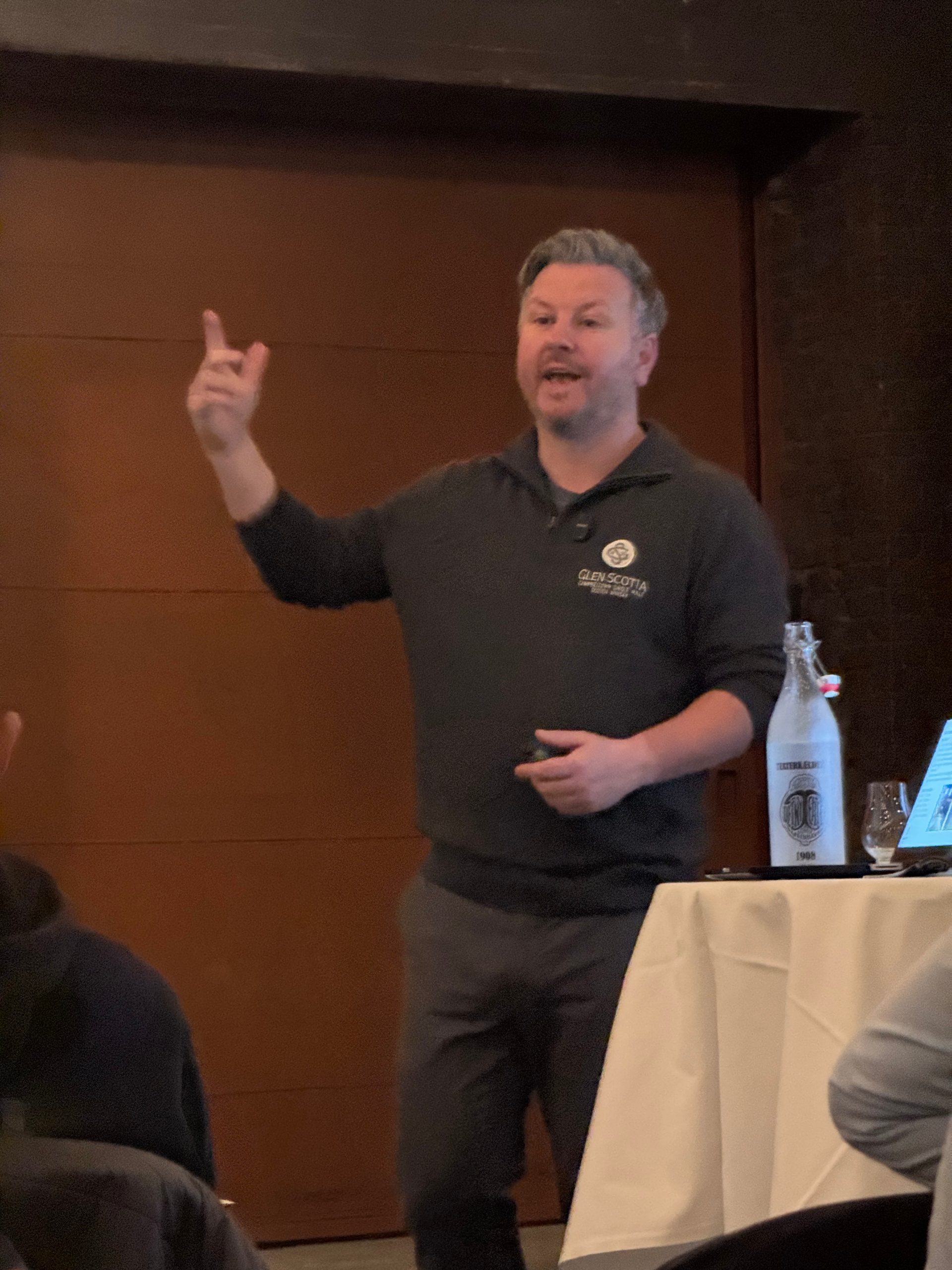
Our Glen Scotia tasting ran to eight whiskies in one evening, hosted by European Brand Ambassador Alan Reid at Juuls in Copenhagen for the shop’s 100th anniversary. The line-up ran from the Double Cask finishes and the core 12 Year Old through Victoriana, the 18, and the World’s Best 25 Year Old, finishing on the medium-peated Campbeltown Malts Festival 2026 release and a heavily peated 2014 single cask bottled exclusively for Juuls. The thread through all of it: maritime salinity, oily fruit, and a Campbeltown character no other region copies. Core bottles run roughly £44 to £120; the 25 sits near £600.
There are distilleries you read about. And then there are distilleries you only truly understand once the glass is full.
Glen Scotia is the second kind. And this evening, we went all the way.
A distillery that should be dead but isn’t
Campbeltown was once the whisky capital of the world. At its Victorian peak, the town was home to over thirty distilleries. Today there are three.
Glen Scotia is one of them, and it has cost. Founded in 1832, the distillery has survived bankruptcies, closure, and the kind of quiet decline that usually turns out to be permanent. New owners arrived in 2014, and something has shifted since. In 2021, their 25 Years Old was named World’s Best Single Malt Whisky at the World Whisky Awards.
This is not a small distillery flexing. It’s a small distillery making whisky the old way and winning anyway.
How Glen Scotia makes its whisky and why it tastes the way it does
Glen Scotia uses an unusually long fermentation process on both peated and unpeated malt. Combined with slow distillation in traditional pot stills, this produces a whisky with real character: oily, fruity, full-bodied, and depending on the malt, a peaty depth that is unlike anything else.
It is craft in the sense that words like “scalable” and “efficient” have never had a place in the production. You can taste that.
The evening’s eight: What we tasted, and what it told us
Glen Scotia Double Cask PX Sherry Cask Finish 46% ABV
The starting point for the evening. The PX sherry cask brings a sweet, dried-fruit character with raisins and dark chocolate. A good introduction to the distillery’s ability to let cask maturation speak without drowning out the spirit’s own foundation.
Glen Scotia Double Cask Bordeaux Red Wine Cask Finish 46% ABV
Same series, very different result. The Bordeaux cask pulls toward fresh red berries and a light dryness that feels closer to a good glass of wine than a classic whisky. Fun and different and a clear demonstration of how much the cask decides.
Glen Scotia 12 Years Old 46% ABV
This is where you meet Glen Scotia’s core character without any decoration. Maritime salinity, fresh fruit, gentle oak. It’s the whisky that explains what Campbeltown actually tastes like — and a useful lesson to carry with you as the evening continues.
Glen Scotia Victoriana 54.2% ABV
One of the most interesting whiskies in the range. Deeply toasted oak, dark brown sugar, a thread of smoke in the background. The high ABV is there but it isn’t aggressive. Victoriana is named after the town’s golden era, and there is something fittingly weighty and considered about it.

Glen Scotia 18 Years Old 46% ABV
Age starts to leave its clear mark here. More tropical fruit, more complexity, and a peaty undertone that has grown softer with time. This is the whisky that begins to do something to you not because it’s dramatic, but because it takes its time.
Glen Scotia 25 Years Old 48.8% ABV “World’s Best Single Malt 2021”
Some awards are a little random. And then there are those that make sense the moment you put your nose over the glass.
Twenty-five years of Campbeltown-style maturation produces a whisky that has kept its freshness while everything else has grown deeper and more integrated. Fresh fruit, wax, a hint of smoke, a long and salty finish. It delivers on what the award promises.
Glen Scotia 25 Year Old — tasting note
Nose: fresh orchard fruit, beeswax, sea spray, a whisper of smoke
Palate: ripe fruit, salinity, integrated oak, soft spice
Finish: long, salty, gently smoky
ABV: 48.8% | Cask: American oak, married in first-fill bourbon | Price: ~£600

Glen Scotia 7 Years Old Medium Peated Campbeltown Malts Festival 2026 53.9% ABV
This year’s festival release. Seven years in first-fill bourbon casks, followed by six months in a ruby Port cask. The result is visible before you even taste it that blush pink colour in the glass isn’t a gimmick, it’s what the Port cask actually does to the whisky.
On the palate: red berries and warm spice from the Port finish, soft smoke from the medium-peated malt, and the maritime salinity that is always present with Glen Scotia. Bottled at cask strength, non-chill filtered. This year’s festival release lives up to the series’ reputation.

Glen Scotia Vintage 2014 Heavily Peated Juuls 100th Anniversary 56.3% ABV
The special cask of the evening. A heavily peated single cask, bottled exclusively for our 100th anniversary.
Here the smoke is not a background note. It is upfront, dense and peaty, but not one-dimensional. Behind it sits the fruit and the oily Glen Scotia texture that holds everything together. At 56.3%, this is a full cask strength experience, and there is good reason to take it slowly.

This is the kind of whisky that reminds you that Glen Scotia’s peated production runs for only a few weeks each year. It is rare, and you can taste that.
| Whisky | ABV | Cask | Profile in one line |
|---|---|---|---|
| Double Cask PX Sherry Finish | 46% | Bourbon + PX sherry finish | Raisins, dark chocolate, dried fruit |
| Double Cask Bordeaux Finish | 46% | Bourbon + Bordeaux red wine finish | Fresh red berries, light dryness |
| 12 Year Old | 46% | Bourbon | Maritime salinity, fresh fruit, gentle oak |
| Victoriana | 54.2% | Heavily charred oak + PX | Toasted oak, dark brown sugar, background smoke |
| 18 Year Old | 46% | Bourbon / refill | Tropical fruit, softened peat, depth |
| 25 Year Old | 48.8% | American oak, married in first-fill bourbon | Fresh fruit, wax, light smoke, long salty finish |
| 7yo Medium Peated, Festival 2026 | 53.9% | First-fill bourbon + 6mo ruby Port | Red berries, warm spice, soft smoke, brine |
| Vintage 2014 Heavily Peated, Juuls 100th | 56.3% | Single cask, heavily peated | Dense peat smoke, fruit, oily texture |
Alan Reid: The brand ambassador who actually does the work
The evening was hosted by Alan Reid, European Brand Ambassador for Glen Scotia. It’s a title many people carry. Fewer do anything with it.
Alan manages to make Glen Scotia’s complex history and production philosophy genuinely understandable without dumbing it down. He is a storyteller first and a salesperson last and that difference becomes very clear over the course of a three-hour tasting. The tasting is conducted in clear, accessible English.

What the Glen Scotia tasting actually showed
Eight whiskies from one distillery might sound repetitive. It is the opposite.
Glen Scotia has enough character to carry a full evening of comparison, and enough variation in cask maturation and age to hold your attention the whole way through. From the Double Cask series to the 25 Year Old and on to the anniversary cask, a single thread runs through it all: maritime salinity, fruity richness, and a craft that doesn’t shift its style to follow trends.
Campbeltown is still a place that makes whisky on its own terms. Glen Scotia is the proof that it works.
Glen Scotia prices and where to buy
The core range is widely available and ships internationally. As a guide (UK RRP): the Double Cask sits around £40, the 12 Year Old around £44, Victoriana around £75, the 18 Year Old around £115–£120, and the World’s Best 25 Year Old around £600.
The Campbeltown Malts Festival 2026 release (7yo, medium peated, ruby Port finish, 53.9%, cask strength, non-chill filtered) is a limited
festival bottling, so availability is patchy and best chased through
specialist retailers. The 2014 Heavily Peated single cask was bottled
exclusively for Juuls’ 100th anniversary and is not part of the general range.
Glen Scotia is stocked at The Whisky Exchange, Master of Malt, Hard To Find Whisky and The Whisky Shop, all of which ship across Europe and beyond.
The evening’s whiskies were presented by Alan Reid, European Brand Ambassador for Glen Scotia Distillery, founded 1832, Campbeltown.
Frequently asked questions
What is Glen Scotia?
Glen Scotia is one of only three working distilleries left in Campbeltown, on Scotland’s west coast. Founded in 1832, it makes oily, full-bodied single malt with a distinct maritime salinity, in both peated and unpeated styles. Its 25 Year Old was named World’s Best Single Malt in 2021.
What does Glen Scotia whisky taste like?
Glen Scotia has a recognisable Campbeltown character: coastal salinity, oily texture, and ripe fruit, with a fine seam of smoke running through the peated expressions. Long fermentation and slow pot-still distillation give it real weight and depth rather than a light, easy profile.
Is the Glen Scotia 25 Year Old really the world’s best whisky?
The Glen Scotia 25 Year Old won World’s Best Single Malt honours in 2021, beating thousands of entries. At 48.8% ABV, matured in American oak and married in first-fill bourbon, it keeps a fresh fruitiness alongside wax, light smoke and a long salty finish. UK RRP sits around £600.
How much does Glen Scotia cost?
Glen Scotia core bottles range from roughly £40 for the Double Cask and £44 for the 12 Year Old, up to about £75 for Victoriana and £115–£120 for the 18 Year Old. The 25 Year Old is the flagship at around £600. Festival and single-cask releases are priced higher and sell out fast.
What is the Campbeltown Malts Festival 2026 Glen Scotia release?
It is Glen Scotia’s annual festival bottling: a 7-year-old medium-peated single malt matured in first-fill bourbon for seven years, then finished six months in a ruby Port cask. Bottled at 53.9% cask strength and non-chill filtered, with a blush-pink colour from the Port.
Where can I buy Glen Scotia whisky?
The core range is stocked internationally at The Whisky Exchange, Master of Malt, Hard To Find Whisky and The Whisky Shop, all of which ship across Europe. Limited festival and single-cask releases are best chased through specialist retailers or the distillery’s own shop while stocks last.
Leave a Reply