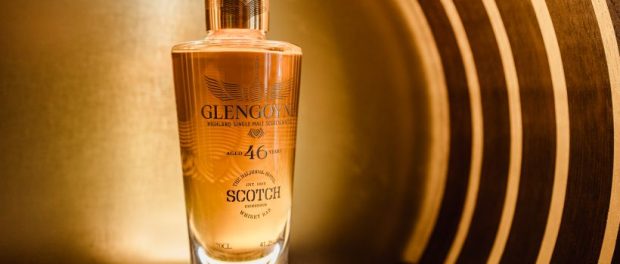
Glengoyne 1979 46-year-old single casks end their lives sealed, catalogued and sold to the highest bidder. This one is being opened.
SCOTCH at The Balmoral in Edinburgh has secured a single bottle of Glengoyne distilled in 1979 and left undisturbed in the distillery’s Warehouse Eight for 46 years. There is exactly one bottle, it will not be sold, and it will be poured to guests by the dram until it runs out. Ross Barr, who manages SCOTCH, wanted a whisky that works as “a moment in time.” Once the last dram is gone, it is gone for good.
What makes it worth writing about is not just the age. It is the cask. Glengoyne built its name on European oak and Oloroso sherry, the rich, spiced, full-bodied style most drinkers picture when they hear the name. This 1979 is the opposite end of the distillery’s range: a refill American oak bourbon barrel, chosen precisely because it lets the distillery’s own character sit in the glass rather than the wood.
The key facts
Distillery: Glengoyne (Dumgoyne, on the Highland/Lowland line north of Glasgow)
Vintage: 1979, bottled at 46 years old
Cask: single refill (second-fill) ex-bourbon American oak barrel
ABV: 41.2%, natural strength, not reduced
Bottles:one, a genuine one-of-one
Where: SCOTCH at The Balmoral, 1 Princes Street, Edinburgh
How it is sold: by the dram only, no bottle for sale
Selected by: Ross Barr and the SCOTCH team with Glengoyne distillery manager Robbie Hughes
Why a bourbon cask is the surprise here
Glengoyne’s house style leans on sherry and European oak. So a 46-year-old that spent its life in American oak was never going to taste like the distillery’s headline bottlings, and that is the point.
The cask itself has a long history before any Glengoyne went near it. By Hughes’s account it likely started out in the early 1960s, held bourbon for five or six years in the United States, then travelled to Glengoyne late that decade. It was filled with Glengoyne once, matured for roughly eight to ten years, emptied, and then refilled with new-make spirit in 1979. From there it sat quietly in Warehouse Eight, sampled maybe once or twice in nearly half a century.
A cask that has already given up most of its first-fill intensity does something specific over that long a stretch: it seasons the spirit slowly instead of swamping it. The result, at 46 years old, is light and distillate-led rather than dark and oak-heavy. As Hughes put it, after that long you want the memory of where the whisky started, not a glass of wood.
What it tastes like
We have not put this one in front of the TDW glass, so treat the notes below as the impressions Barr and Hughes shared on the day rather than a full independent review. A proper TDW tasting will follow if we get to the dram.
Glengoyne 1979 46 Year Old, refill bourbon cask, tasting notes
Nose: powdered sugar, fresh citrus, a lift of raspberry pavlova, honey, American oak coconut and vanilla, light wood spice. Delicate and fresh rather than heavy.
Palate: honeyed and noticeably oily in texture, green apple and pear from Glengoyne’s fruit-forward new-make, coconut and vanilla from the American oak, gentle spice. The distillery, not the cask, leads.
Finish: gently spiced and honeyed, the fruit holding on.
ABV: 41.2% | Cask: refill ex-bourbon American oak | Age: 46 years (1979)
Why Glengoyne can never make this whisky again
The most quotable line of the day came from Hughes: even with the same distillery, “we can’t reproduce this whisky.” Three things have changed since 1979.
The water source moved. In 1979 Glengoyne drew from the hill above the distillery; from 1981 it switched to Loch Katrine. The barley changed too. This spirit was 100% Golden Promise, the heritage variety that ran through the 1970s and 1980s before being phased out, gone entirely by around 2007, and it is Golden Promise that gives the whisky its oily weight. Finally the stills changed. In 1979 they were around 16% smaller, and the lyne arm ran uphill at roughly a 7.7% incline. When the stills were enlarged in 1991 the condensers stayed put, which turned that incline into a slight decline and shifted the spirit character.
Add Glengoyne’s slow distillation, the slowest stills in Scotland, and you have a spirit fingerprint that no longer exists. There is one more human detail: one of the stillmen who actually made this spirit in 1979, Duncan McNicol, is Hughes’s next-door neighbour, retired only a few years ago and still around to tell the story.
Who makes it: Glengoyne in brief
Glengoyne was founded in 1833 and sits at Dumgoyne, north of Glasgow, on the boundary between the Highlands and Lowlands. It distils on the Highland side and matures its casks in warehouses on the Lowland side of the road, a quirk that international readers often find odd and locals rather enjoy.
The distillery is unpeated, air-dries its barley, bottles at natural colour, and runs what it calls the slowest stills in Scotland to build a clean, fruity, slightly oily spirit. Robbie Hughes has been distillery manager since 2003, and before Glengoyne he worked at 13 other distilleries. Glengoyne is owned by Ian Macleod Distillers, which also holds Tamdhu and Rosebank.
Where to try it, and can you buy a bottle
You cannot buy a bottle, because there isn’t one to buy: the single bottle stays at SCOTCH and is served by the glass. To taste it you go to SCOTCH at The Balmoral, 1 Princes Street, Edinburgh, and order it while it lasts.
This is the same model SCOTCH used for its one-of-one 1945 Glen Grant from Gordon & MacPhail, which the bar offered by the dram over the 2025 festive season. A per-dram price for the Glengoyne had not been published at the time of the announcement. If it follows the pattern of SCOTCH’s other rare-by-the-dram pours, expect it to sit at the serious-collector end. For readers travelling to Edinburgh, this is the relevant point: it is a pour you can actually experience without buying the whole bottle or winning an auction.

Our take
For a whisky drinker, the appeal is straightforward. This is a rare chance to taste a 46-year-old Glengoyne in a guise the distillery almost never shows: American oak, natural strength, distillate-forward, from barley and stills that no longer exist. If your interest is old refill-cask Highland malt where the spirit does the talking, it is worth planning a visit around. If you only love the big sherried Glengoyne style, this one will read as a different animal, and that is exactly why it is interesting.
The wider story is what SCOTCH keeps doing: taking bottles that would normally vanish into a display case and putting them in glasses. That is good for anyone who would rather drink history than store it.
Frequently asked questions
What is the Glengoyne 1979 46 Year Old? It is a single-bottle Glengoyne single malt distilled in 1979 and matured for 46 years in a refill ex-bourbon American oak barrel. Bottled at 41.2% natural strength, it is a one-of-one held at SCOTCH, The Balmoral in Edinburgh, and served only by the dram.
What does the Glengoyne 1979 taste like? Based on the on-camera tasting by SCOTCH and Glengoyne, it is delicate and fresh rather than heavy: powdered sugar, citrus, raspberry pavlova and honey on the nose, then an oily palate of green apple, pear, coconut and vanilla with gentle spice. The distillery character leads, not the oak.
Can I buy a bottle of the Glengoyne 1979 46 Year Old? No. There is only one bottle and it is not for sale. SCOTCH pours it by the dram until it is finished. To taste it you visit SCOTCH at The Balmoral, 1 Princes Street, Edinburgh, and order a measure while stock remains.
How much does a dram cost? A per-dram price was not published when the bottle was announced. SCOTCH has previously offered one-of-one whiskies, such as a 1945 Glen Grant, by the dram at the top of its price list, so expect a premium pour rather than an everyday measure.
Why can’t Glengoyne make this whisky again? Three production elements have changed since 1979: the water source moved from the hill to Loch Katrine in 1981, the 100% Golden Promise barley was phased out and gone by around 2007, and the stills were enlarged in 1991, altering the lyne arm angle and spirit character. The 1979 fingerprint no longer exists.
What cask is it from? A single refill (second-fill) ex-bourbon American oak barrel. It is unusual for Glengoyne, which is known for Oloroso sherry and European oak. The refill bourbon barrel matured the spirit gently over 46 years, keeping it light and distillate-forward instead of oak-dominated.
Leave a Reply