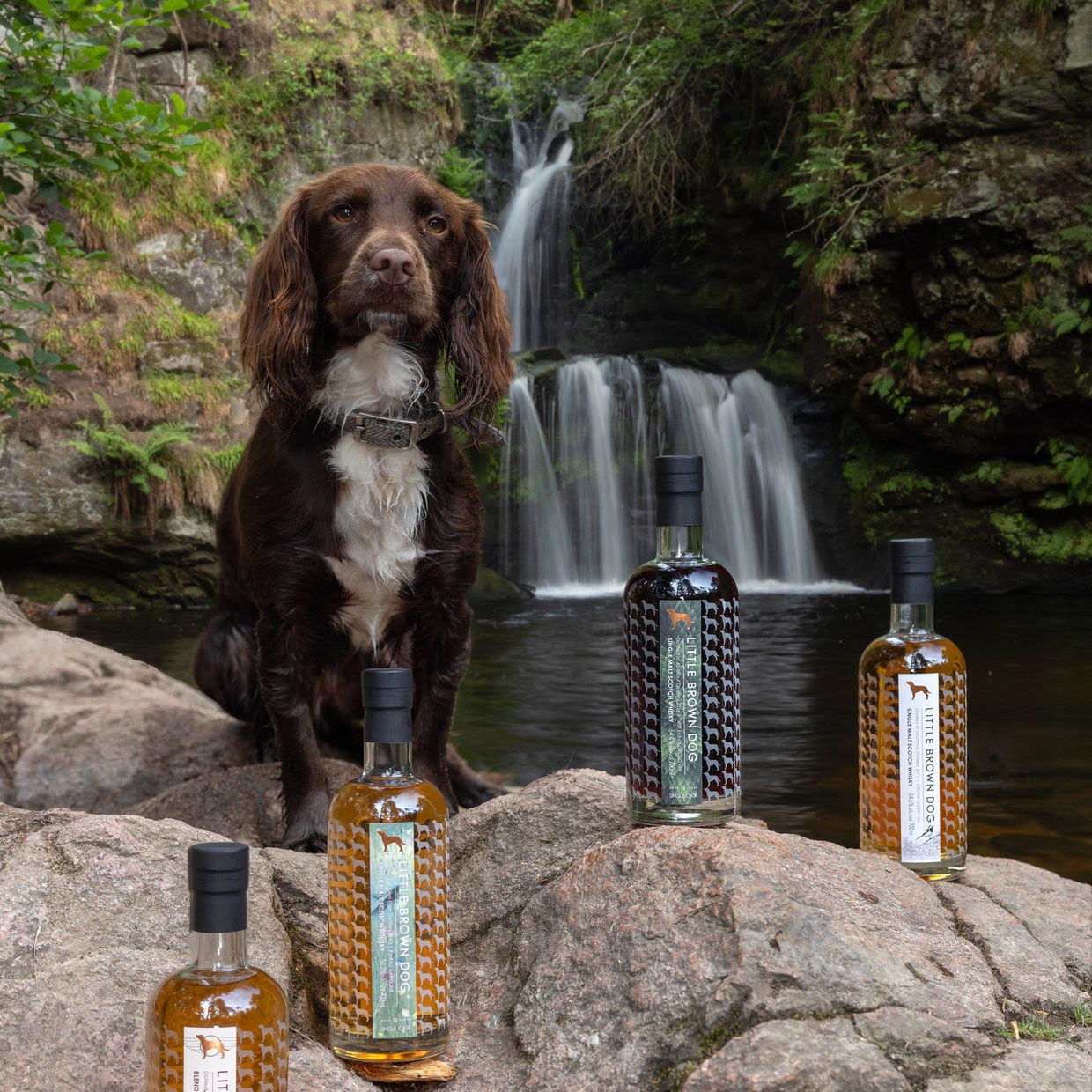
Little Brown Dog whisky has released a seven-bottle batch, the Aberdeenshire bottler’s biggest single drop yet. It runs from a first-fill Oloroso Aberlour 2014 at cask strength (54.4%, 310 bottles, one per customer) to a 36-year-old teaspooned Balvenie at 47.6%, taking in single casks of Glen Elgin, Strathmill and an undisclosed Orkney malt along the way. Two crowd-pleasers round it out: the final vatting of the blended-malt Drookit Dug (45.1%, 800 bottles) and the return of their high-rye Scottish spirit. Everything is natural colour and non-chill filtered. Available direct from littlebrowndogspirits.com and specialist retailers with UK and selected international shipping.
What is the new Little Brown Dog whisky batch?
Seven bottles at once is a lot for a small independent bottler. This is Little Brown Dog whisky at its most ambitious: four single casks, a new small-batch release, the last liquid from a long-running blended malt, and the comeback of a Scottish take on bourbon.
The headline numbers tell the story. Ages run from around eight years to a full 36. Outturns run from 265 bottles up to 800. Nothing here is coloured or chill filtered, and several are bottled at cask strength. If you have been meaning to try LBD but were waiting for the right cask, this batch gives you seven ways in.
Here are the key facts before anything else.
| Bottle | Distillery / type | Cask | Age | Outturn | ABV | RRP (direct) |
|---|---|---|---|---|---|---|
| Aberlour 2014 | Aberlour, Speyside single malt | 1st-fill Oloroso hogshead | 11 yo | 310 | 54.4% (cask strength) | £89 (sold out direct) |
| Burnadjacent 1989 | Teaspooned Balvenie, blended malt | Refill hogshead | 36 yo | 321 | 47.6% | £160 (sold out direct) |
| Glen Elgin 2013 | Glen Elgin, Speyside single malt | Refill Pineau des Charentes barrique | 13 yo | 265 | confirm | £60 |
| Orkney 2001 | Undisclosed Orkney single malt | Two refill hogsheads, vatted | c. 24 yo | 428 | confirm | £99 |
| Strathmill 2015 | Strathmill, Speyside single malt | Cream sherry hogshead | 11 yo | 286 | confirm | £76 |
| Drookit Dug (Last Batch) | Blended malt Scotch | 2nd- and 3rd-fill hogsheads | NAS | 800 | 45.1% (cask strength) | £44.50 |
| Scottish Spirit 2017 (High Rye, Batch 2) | Invergordon, Scottish grain | Virgin American oak | c. 8 yo | 300 | confirm | £44 |
Who is Little Brown Dog and why this batch matters
Little Brown Dog Spirits is an independent bottler and micro-distillery at West Aquhorthies Farm in Fetternear, rural Aberdeenshire. It was founded in 2018 by the vet Andrew Smith and the farmer Chris Reid, and named after Smith’s dog Banksy, whose nickname was the little brown dog. Banksy passed in 2022 and still appears on the labels.
Two things define the house style. The first is transparency: LBD publish their methods and ingredient origins, and every bottle carries a QR code linking to batch-specific data, right down to what3words locations for foraged botanicals and the full cask make-up of their blends. The second is a refusal to take the marketing too seriously, which is why you get names like Wee Mongrel, Drookit Dug and Burnadjacent sitting next to seriously good liquid.
For international readers, that combination is the point. This is small-scale, cask-by-cask bottling from someone who watches each barrel in their own warehouse and pulls it when it is ready, not on a schedule. A seven-bottle batch is simply more of that at once than usual.
The four single casks
Aberlour 2014 is the one people will chase, hence the one-per-customer cap. Eleven years in a first-fill Oloroso hogshead has taken it to filter-coffee brown, all natural, and to 54.4% at cask strength. This is the classic sherried Speyside profile done at full volume.

Glen Elgin 2013 is the quiet technician’s pick. Glen Elgin uses worm-tub condensers, which give a heavier, meatier spirit that rewards a gentle hand with wood, and LBD have matched it to a single refill Pineau des Charentes barrique rather than anything aggressive. At 265 bottles it is the smallest outturn in the batch.
Orkney 2001 is a vatting of two sister refill hogsheads, both with low fill levels. Low fills cost you volume but they push oxidation, and here around 24 years in gentle refill wood has done the slow, unforced work that long maturation is all about. LBD keep the distillery name under wraps, so all we can say is it comes from Orkney.
Strathmill 2015 shines a light on a genuinely under-bottled Speysider. Tucked away in Keith and best known for its role in the J&B blend, Strathmill rarely appears as a single malt, which makes an 11-year-old from a cream sherry hogshead a treat for anyone building out their Speyside map.
The small batch and the last-ever Drookit Dug
Drookit Dug has been one of LBD’s most popular blended malts, and this is the end of the line for it. This bottling is the final liquid from a vatting that has been running since batch two, drawn from casks that gave up more than their share to the angels and left it at 45.1%, which is its natural cask strength here. After the initial vatting it carried on quietly in second- and third-fill hogsheads. Eight hundred bottles, and then it is gone.
Burnadjacent 1989 is the trophy. This is a 36-year-old teaspooned Balvenie, which needs a word of explanation for readers outside the trade. Teaspooning is when a tiny measure of a different single malt is added to a cask so that it must legally be sold as blended malt and the original distillery cannot be named. Independent bottlers then give it a cover name, and Burnadjacent is LBD’s wink at where the whisky is from. What matters is the liquid: a refill hogshead has let this reach the tropical fruit character that only turns up in very old malt, and at 47.6% after 36 years it has held its strength beautifully.

Scottish Spirit 2017: a Scottish answer to bourbon
The batch also brings back what LBD cheerfully call their Scottish bourbon. It cannot legally be called bourbon, because bourbon is a US category, so it is labelled as a spirit drink: a high-rye spirit distilled at the Invergordon grain distillery and matured in virgin American oak, the same new-charred oak that gives bourbon its backbone. This is Batch 2 of the High Rye, distilled in 2017 and bottled in October 2025. If you like rye-forward American whiskey and are curious what the style tastes like made in Scotland, this is a rare chance to compare.
Tasting notes (as published by Little Brown Dog)
These are LBD’s own notes. We have not tasted this batch, so treat them as the bottler’s guidance rather than a Daily Whisky verdict.
Aberlour 2014 Colour: filter coffee
Nose: black cherry jam, cacao, pencil case
Palate: dark chocolate Brazil nuts, boozy clootie dumpling
Finish: hot honey, coffee cake
Burnadjacent 1989 (36 yo) Colour: blushing grapefruit skin
Nose: kiwi, mandarin, old bookshop
Palate: peach iced tea, fresh mango with lime
Finish: pecan pie, sea salt, good olive oil
Glen Elgin 2013 Colour: champagne
Nose: blackcurrant Chewits, white tea, apricot jam
Palate: Madeira cake, grenadine, cognac
Finish: candied ginger, light tamarind, fresh rocket
Orkney 2001 Colour: polished buttons
Nose: salted caramel, apple skins, petrichor
Palate: raspberry ripple ice cream, plain loaf, grilled red peppers
Finish: smoked almonds, quince jelly
Strathmill 2015 Colour: Haribo peach sweets
Nose: old oak furniture, rowan jelly, Grand Marnier
Palate: custard doughnut, pink grapefruit, port glaze
Finish: Sancerre, pear soda, mace
Drookit Dug (Last Batch) Colour: gold medal
Nose: Muscat grapes, toasted brioche, pineapple cubes
Palate: buttered toast, cookie dough, beeswax
Finish: Carnation milk, candy floss, runny honey
Scottish Spirit 2017 (High Rye, Batch 2) Colour: mid-century furniture
Nose: kirsch, pumpkin spice, pencil case
Palate: pancakes and maple syrup, candied violet, malt loaf
Finish: spearmint, rosemary, nutmeg
Price and availability
Little Brown Dog sells direct from littlebrowndogspirits.com, and the range is carried by UK and European specialists including Abbey Whisky, The Strong Water Co, Robbie’s Drams, the Inverurie Whisky Shop and Milroy’s of Soho, several of which ship internationally. For readers in the rest of the EU, the direct shop and The Strong Water Co are the usual routes.
Direct RRPs are keen for what these are. The Scottish Spirit is £44 and the final Drookit Dug £44.50, the Glen Elgin £60, the Strathmill £76, the Aberlour £89 and the Orkney £99, with the 36-year-old Burnadjacent at £160. In euros that is roughly €51 to €187, before shipping and any local duty. For a first-fill Oloroso single cask at cask strength, £89 is fair, and £160 for a 36-year-old malt is close to a bargain by today’s aged-whisky standards.
Move quickly if you want the headliners. These are small outturns, from 265 to 800 bottles, the Aberlour was capped at one per customer, and at the time of writing on 12 August 2026 both the Aberlour and the Burnadjacent had already sold out directly from LBD. If they are gone from the shop by the time you read this, the specialist stockists above are your next stop, and it is worth setting an alert for LBD’s next batch.
The verdict: who this batch is for
This is the batch to point three different drinkers at. The sherry lover goes straight to the first-fill Oloroso Aberlour. The collector of old and unusual malt goes to the 36-year-old Burnadjacent, the bottle of the batch at £160 and sharply priced for its age, though it sold out direct almost immediately. Everyone else has an easy entry point in the last Drookit Dug or, if you want something genuinely different, the high-rye Scottish spirit.
If you are new to Little Brown Dog, start with Drookit Dug while it lasts and use the QR-coded transparency to see exactly what you are drinking. If you already know the brand, the Glen Elgin and the Strathmill are the connoisseur picks: two under-the-radar Speysiders bottled with a light enough touch to let the distillery character lead.
Whatever you go for, act on the single casks. At these outturns the good ones will not hang around.
FAQ
What is the new Little Brown Dog whisky batch? It is a seven-bottle release from Aberdeenshire independent bottler Little Brown Dog, bottled in July 2026. It includes single casks of Aberlour, Glen Elgin, Strathmill and an undisclosed Orkney malt, a 36-year-old teaspooned Balvenie, the final batch of the blended-malt Drookit Dug, and a high-rye Scottish spirit. All are natural colour and non-chill filtered.
What is the oldest whisky in the Little Brown Dog batch? The oldest is Burnadjacent 1989, a 36-year-old teaspooned Balvenie bottled as a blended malt from a refill hogshead at 47.6% ABV, with an outturn of 321 bottles. Teaspooning means a tiny amount of another malt was added so the original distillery cannot be named, hence the cover name Burnadjacent.
How much does the Little Brown Dog whisky batch cost? Per-bottle prices were not stated in the release. Check littlebrowndogspirits.com and specialist retailers for current RRPs. As a guide, LBD’s younger single casks generally sit in the mid-double to low-triple figures in GBP, while the 36-year-old Burnadjacent carries a significant premium as an aged, single-outturn bottling.
Where can I buy Little Brown Dog whisky? Direct from littlebrowndogspirits.com and from specialist retailers including Abbey Whisky, The Strong Water Co, Robbie’s Drams, the Inverurie Whisky Shop and Milroy’s of Soho. Several offer UK and selected international shipping, so EU and other overseas buyers can usually order, subject to local import rules.
Is the Little Brown Dog whisky batch cask strength? Some of it. The Aberlour 2014 is cask strength at 54.4% and the last Drookit Dug is at its natural cask strength of 45.1%. The Burnadjacent 1989 is 47.6%. The Glen Elgin, Orkney, Strathmill and Scottish Spirit ABVs should be confirmed from the product pages, as LBD single casks are frequently, but not always, bottled at full strength.
Who is Little Brown Dog? Little Brown Dog Spirits is an independent bottler and micro-distillery in Fetternear, Aberdeenshire, founded in 2018 by Andrew Smith and Chris Reid and named after Smith’s dog. It is known for single casks, blended malts like Wee Mongrel and Drookit Dug, foraged gin, and a transparent, QR-coded approach that publishes cask and ingredient detail.
Leave a Reply