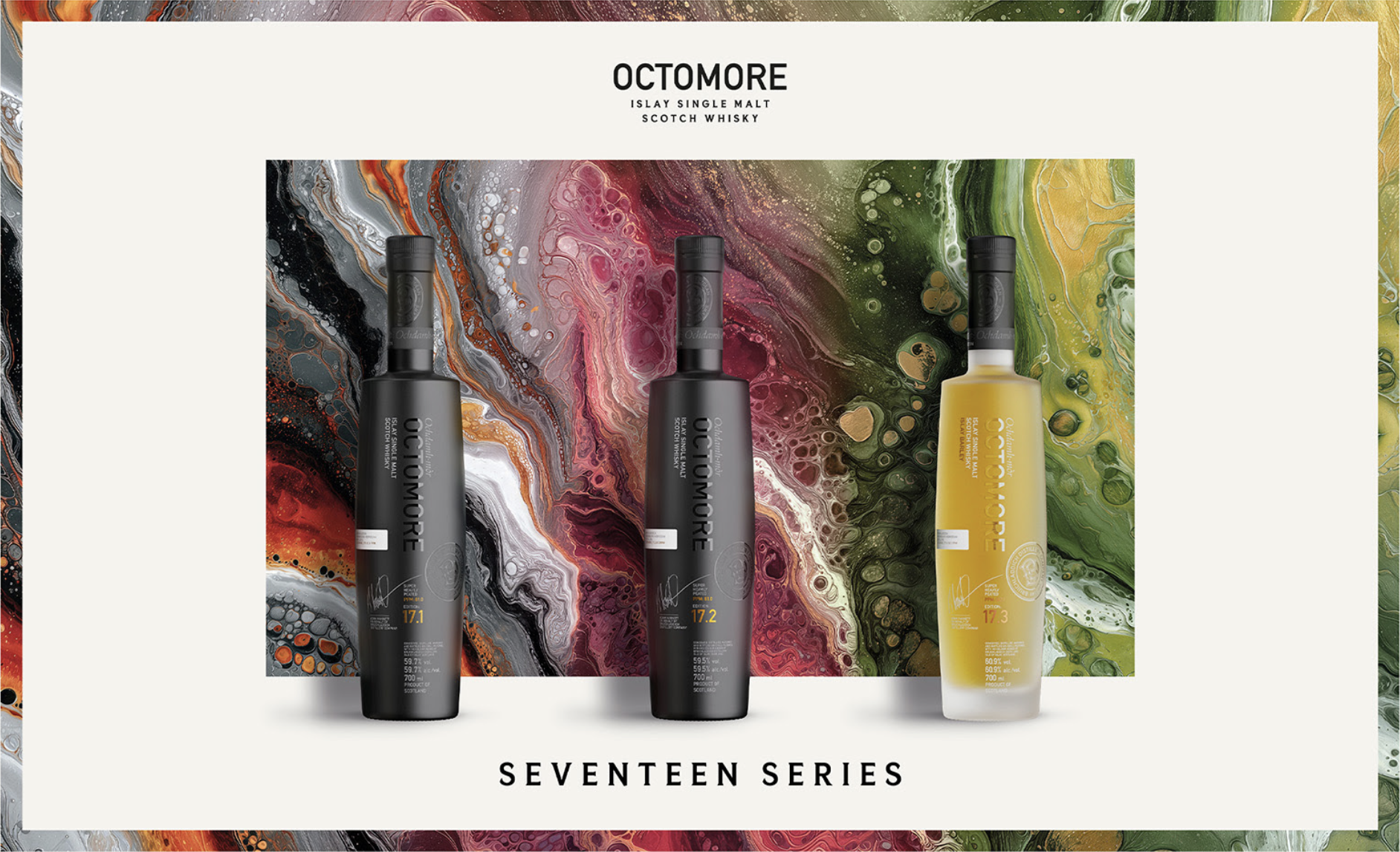
Bruichladdich has just released the Octomore 17 Series, and the headline number belongs to 17.3: 132.1 PPM, one of the most heavily peated single malts the distillery has ever bottled. This is the annual moment peat drinkers wait for, and the 17 Series arrives under a new banner, Chromatic Signatures, with three core five-year-old Islay single malts spanning bourbon, Port and a five-cask farm-grown expression.
Octomore is Bruichladdich’s answer to a simple provocation: how far can you push peat and still make something refined? The 17 Series keeps three constants that define the range. Every expression is five years old, matured in full at the distillery on Islay, and bottled at cask strength with no colouring and no chill filtration. What changes each year is the barley, the peating level and the casks, and this year those variables have been pulled a long way apart.
What is the Octomore 17 Series?
The Octomore 17 Series is the 2026 annual release of Bruichladdich’s super heavily peated Islay single malt. It launches with three expressions, 17.1, 17.2 and 17.3, all five years old and all bottled at cask strength. Edition 17.1 is the bourbon-cask benchmark at 81 PPM and 59.7% ABV. Edition 17.2 takes the same barley into Port casks at 81 PPM and 59.5% ABV. Edition 17.3 is the farm-grown showpiece, peated to 132.1 PPM and bottled at 60.9% ABV. UK RRPs run from £142.95 to £199.95, with international shipping available through the major specialists.
Who makes Octomore, and why the numbers matter
Octomore is made at Bruichladdich Distillery in Port Charlotte on the Isle of Islay, off Scotland’s west coast. The distillery rebuilt its reputation in the 2000s on transparency and terroir, tracing barley to specific farms and harvests, and Octomore is where that thinking is pushed to its limit. Master blender Adam Hannett oversees the range, and his framing this year is that each release is a snapshot of one harvest and one cask selection, which makes every edition inherently scarce.
Two numbers do the heavy lifting on an Octomore label. PPM measures phenols in the malted barley, the compounds that carry peat smoke, and Octomore routinely posts figures that dwarf classic Islay bottlings. ABV is the bottling strength, and Octomore is always cask strength, so the intensity you read on the label is the intensity in the glass. The trick, and the reason the range has the following it does, is that the spirit carries those numbers with sweetness and clarity rather than tar and ash.
The three expressions at a glance
| Octomore 17.1 | Octomore 17.2 | Octomore 17.3 | |
|---|---|---|---|
| Series line | Seventeen · One | Seventeen · Two | Seventeen · Three |
| Barley | Scottish mainland Concerto | Scottish mainland Concerto | Islay-grown Concerto (Octomore Farm) |
| Peating | 81 PPM | 81 PPM | 132.1 PPM |
| Casks | First-fill bourbon barrels | Bourbon and Port | Bourbon, Sauternes, Ribera del Duero, Eiswein, Syrah |
| ABV | 59.7% | 59.5% | 60.9% |
| Profile | Vanilla, tablet, dry smoke | Dark berries, chestnut, barbecue | Salted caramel, orchard fruit, deep smoke |
| UK RRP | £142.95 | £157.95 | £199.95 |
| For | The purist who wants the reference point | The fruit-and-smoke drinker | The collector chasing the highest PPM |
Octomore 17.1: the bourbon-cask reference point
Edition 17.1 is the one everything else is measured against. It takes 100% Scottish mainland Concerto barley, malted to 81 PPM, and matures it entirely in first-fill bourbon barrels. Nothing distracts from the interplay of spirit, peat and American oak, which is exactly the point.
Octomore 17.1 tasting notes (Bruichladdich)
Nose: vanilla milkshake, Scottish tablet, warm custard tart, pear drops, malt syrup
Palate: sweet bourbon oak building into dry, earthy smoke, smouldering oak and ash, with salinity cutting through the sweetness
Finish: long, clean and warming, smoke and salt holding over the sugar
ABV: 59.7% | Casks: first-fill bourbon barrels | UK RRP: £142.95

Octomore 17.2: the same barley, taken into Port
Edition 17.2 starts from the same batch of Scottish mainland Concerto as 17.1, peated to the same 81 PPM, then diverts into a mix of ex-bourbon and ex-Port casks. The Port pulls the profile toward dark fruit and roasted sweetness while the bourbon keeps a spine underneath, and the peat rolls through in a wave of barbecue and char.
Octomore 17.2 tasting notes (Bruichladdich / retailer)
Nose: roast chestnut, caramelised citrus peel, red apple, blackberry, a hint of dusty leather
Palate: sweet vanilla, blackberry crumble, dark bramble fruit, roasted chestnut, charred spice with real barbecue attitude
Finish: long, sweet and smoky, dark fruit fading into embers
ABV: 59.5% | Casks: bourbon and Port | UK RRP: £157.95

Octomore 17.3: the farm-grown 132.1 PPM showpiece
Edition 17.3 is the provenance statement of the series and the one that will get the most attention. The barley is Concerto grown in Irene’s Field on Octomore Farm, roughly two miles from the distillery, and it is peated all the way to 132.1 PPM. Maturation spreads across five cask types, first-fill bourbon alongside Ribera del Duero, Sauternes, Eiswein and Syrah, which is why the profile lands closer to salted caramel and orchard fruit than the raw ferocity the PPM figure might suggest. In Hannett’s words, you do not get a higher-provenance whisky than this.
Octomore 17.3 tasting notes (Bruichladdich)
Nose: salted caramel, smoked apple, toasted coconut, praline, vanilla cream
Palate: sweet first-fill oak, orchard fruit and honey layered under muscular campfire smoke, praline and vanilla filling the middle
Finish: long, deep and smoky, sweetness and peat holding together to the end
ABV: 60.9% | Casks: bourbon, Sauternes, Ribera del Duero, Eiswein, Syrah | UK RRP: £199.95

Price and where to buy
The 17 Series is a standard annual release rather than a distillery-exclusive, so it is turning up across the major UK specialists now, with international shipping to Denmark and the rest of Europe, the US and beyond.
Octomore 17.1: £142.95 RRP (around £144 at retail), roughly €165
Octomore 17.2: £157.95 RRP (around £159 at retail), roughly €180
Octomore 17.3: £199.95 RRP (around £201 at retail), roughly €230
All three are 70cl. You will find them at Bruichladdich’s own shop, The Whisky Exchange, Master of Malt and Hard To Find Whisky, most of which ship internationally. If you want the complete flight, several retailers are also listing the three as a bundle.
Our take
If you buy one, make it 17.1. It is the clearest read on what Octomore is doing this year, and at £142.95 it is the entry point to the whole idea. If you want the version that shows off the range’s sweeter, fruit-driven side, 17.2 and its Port casks are the pick. And if you collect by PPM, or you simply want the most complete Octomore statement of provenance, 17.3 is built for you, though at £199.95 it asks a real commitment for a five-year-old.
This is not a range for someone dipping a toe into peat. It rewards drinkers who already know they love smoke and want to see how far intensity and refinement can travel together. Add water in small amounts and give it time. At these strengths, a few drops open the fruit without dulling the smoke.
For collectors, the scarcity framing is genuine: each edition is a single harvest and cask selection, and once a given release sells through it is gone. If the 17 Series matters to you, the time to act is early rather than late.
Frequently asked questions
What is the Octomore 17 Series? The Octomore 17 Series is Bruichladdich’s 2026 annual release of super heavily peated Islay single malt, branded Chromatic Signatures. It launches with three five-year-old cask-strength expressions, 17.1, 17.2 and 17.3, ranging from 81 PPM to 132.1 PPM, with a fourth edition, 17.4, completing the set.
What is the difference between Octomore 17.1, 17.2 and 17.3? All three are five-year-old Islay single malts. 17.1 is matured in first-fill bourbon at 81 PPM. 17.2 uses the same barley in bourbon and Port casks, also 81 PPM. 17.3 is farm-grown Islay barley peated to 132.1 PPM and matured across five cask types, making it the most intense and most complex of the three.
How much does the Octomore 17 Series cost? UK RRPs are £142.95 for 17.1, £157.95 for 17.2 and £199.95 for 17.3, all 70cl. Retail prices sit close to those figures, roughly €165 to €230 in euros. The three are also sold together as a bundle by some retailers.
Where can I buy Octomore 17.1, 17.2 and 17.3? The 17 Series is available now from Bruichladdich’s own shop, The Whisky Exchange, Master of Malt and Hard To Find Whisky. It is a standard annual release rather than a distillery-exclusive, and most of these specialists ship internationally, including to Denmark and the rest of the EU.
Is Octomore 17.3 the most heavily peated whisky in the series? Yes. Octomore 17.3 is peated to 132.1 PPM, well above the 81 PPM of 17.1 and 17.2. Despite the figure, its five-cask maturation gives it notes of salted caramel, orchard fruit and vanilla alongside the deep campfire smoke, which is the balance Octomore is known for.
What is Octomore known for? Octomore is Bruichladdich’s range of super heavily peated single malts, made on Islay and bottled young at cask strength. It is celebrated for pushing peating levels to extremes while keeping the spirit sweet and refined, and for its traceable, farm-specific barley, which puts provenance at the centre of every release.
Leave a Reply