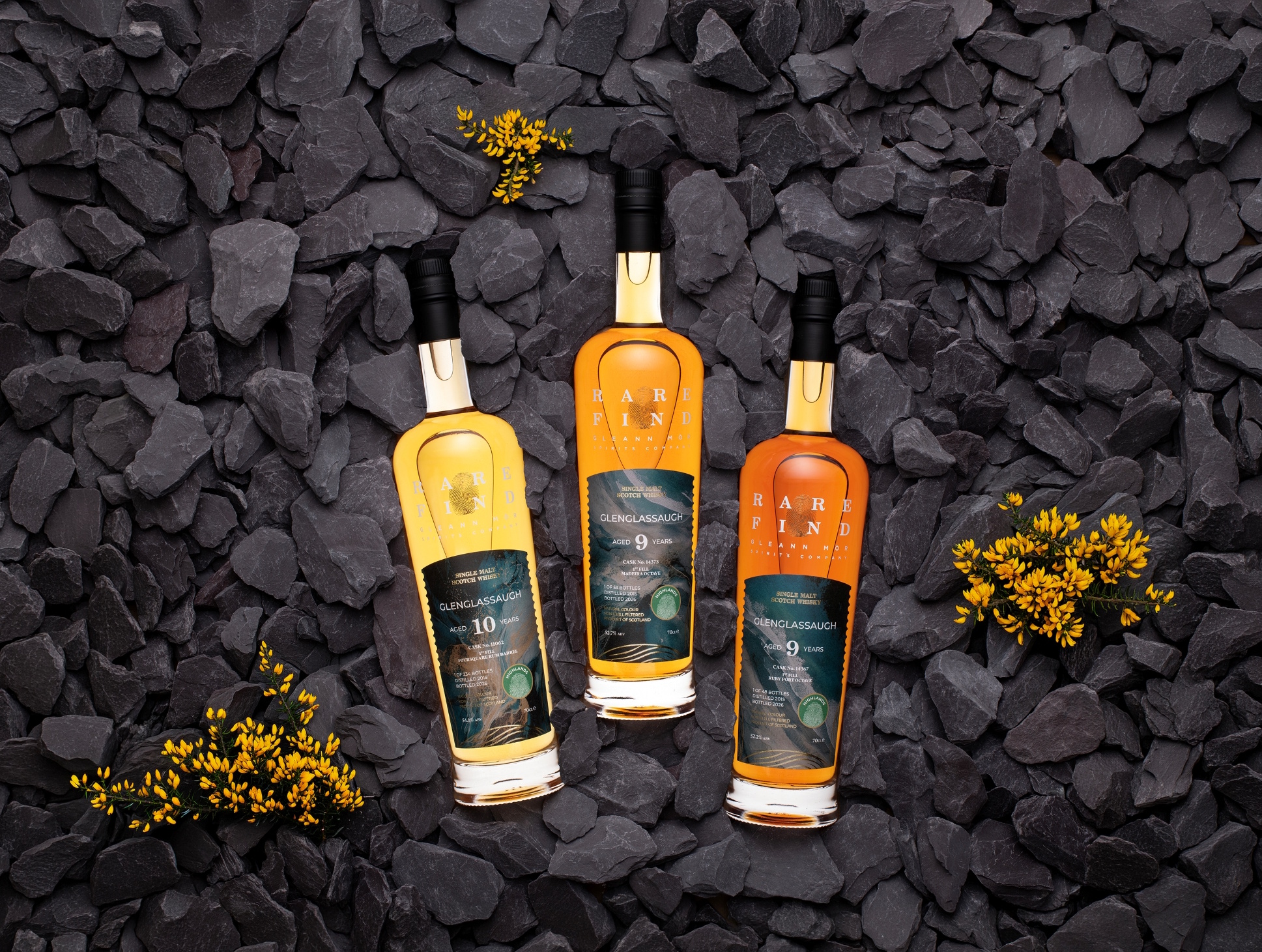
Two of the three whiskies in Rare Find’s new Glenglassaugh Collection exist in quantities of 48 and 53 bottles. That is not a limited edition in the marketing sense. That is one small cask, emptied.
Rare Find, the Edinburgh independent bottler owned by Gleann Mòr Spirits Company, has announced three Glenglassaugh single casks arriving on 30 July 2026. All three come from the same coastal Highland distillery, and all three were put into different finishing wood. The result is about as close to a controlled experiment as independent bottling gets: one spirit, three answers.
The collection lands four weeks after Rare Find’s Summer 2026 collection of four single casks, which makes this the bottler’s second drop in a month.
The three whiskies
Rare Find calls it The Glenglassaugh Collection, and frames it as a trilogy rather than three separate bottlings.
Glenglassaugh 10 Year Old, 54.6% ABV, cask 11062. Finished for 19 months in a first-fill Foursquare rum barrel. 234 bottles. Foursquare is the Barbados distillery that has spent the past decade becoming the reference point for unadulterated rum, and its casks are increasingly sought after by Scotch bottlers.

Glenglassaugh 9 Year Old, 52.7% ABV, cask 14373. Finished for 11 months in a first-fill Madeira octave. 53 bottles.

Glenglassaugh 9 Year Old, 52.2% ABV, cask 14367. Finished for 11 months in a first-fill ruby port octave. 48 bottles.

All three are 70cl, bottled at natural cask strength, natural colour and without chill filtration, which is standard practice across the Rare Find range.
Note the cask numbers on the two octaves. 14367 and 14373 sit six apart, which suggests they were filled at or near the same time. Rare Find used a similar approach on the Summer 2026 collection, where the two oloroso quarter casks were numbered 11131 and 11140. If the octaves here were racked from the same parent cask, the comparison between them is even cleaner than it looks, though the bottler has not said so and we have asked.
Why the octaves are so small
An octave holds roughly 50 litres, about an eighth of a standard hogshead. The smaller the cask, the higher the ratio of wood surface to liquid, and the faster the extraction, which we went into in more detail when Rare Find used the same cask format on three Caol Ila 12-year-olds for Fèis Ìle.
That explains two things at once here: why the Madeira and port expressions only yielded 48 and 53 bottles, and why Rare Find pulled them after less than a year. Leave a whisky in an octave too long and the cask stops adding character and starts replacing it.
The rum barrel is a different proposition. A standard barrel at around 200 litres gives a slower, gentler influence, which is why that one sat for 19 months and still produced 234 bottles.
Rare Find has run this experiment before
This is the third time in 2026 that Rare Find has built a release around holding the spirit constant and varying only the wood, and the second time it has used octaves to do it.
In May the bottler put three Caol Ila 12-year-olds into ruby port, tawny port and Madeira octaves for three months each, at £99 a bottle and 190 bottles in total. In June the Summer 2026 collection paired a Dalmunach and a mystery Islay in matched oloroso quarter casks to show how the same active wood behaves over different spirit.
Two of the cask types now repeat. Ruby port octave and Madeira octave have gone over both a heavily peated Islay and an unpeated coastal Highlander, which is a genuinely useful comparison if you already own one of the Caol Ilas. The Caol Ila Madeira came out zesty and mineral with the wine acidity sharpening the peat. The Glenglassaugh Madeira, on Rare Find’s notes, goes towards raisin, digestive biscuit and candied orange, because there is no smoke for the acid to cut against.
Buy the Glenglassaugh port and Madeira alongside the Caol Ila equivalents and you have a four-glass tasting that isolates peat as the variable. That is more interesting than any single bottle in this collection.
Rare Find Glenglassaugh Collection tasting notes
Tasting notes supplied by Rare Find. We have not tasted these bottlings.
Glenglassaugh 10 Year Old, Foursquare rum barrel finish
Nose: wild honey, caramel, peaches, zesty citrus, leafy greenery, underripe banana
Palate: toffee, caramel, lemon-drizzled apricots, golden tobacco, cinnamon stick
Finish:dusty cinnamon and toasted oak fading into stone fruit, with tropical sweetness underneath
ABV: 54.6% | Cask: first-fill Foursquare rum barrel, cask 11062, 19-month finish Outturn: 234 bottles, 70cl | Price: £79
Glenglassaugh 9 Year Old, Madeira octave finish
Nose: orange and lemon zest, plump raisins, digestive biscuits, powdered ginger, red and black berries
Palate: dark berry cordial, chocolate torte, candied orange peel, balanced pepper, cinnamon
Finish: lingering, cinnamon-spiced berries, fading chocolate
ABV: 52.7% | Cask: first-fill Madeira octave, cask 14373, 11-month finish | Outturn: 53 bottles, 70cl | Price: £79
Glenglassaugh 9 Year Old, ruby port octave finish
Nose: strawberry shortcake, raspberries and thick cream, buttery biscuit base, spiced mirabelle plums, milk chocolate
Palate: thickly textured, berry fruits, ginger, cinnamon, chocolate torte, cask char
Finish: long, stewed berry fruit, lingering fine chocolate
ABV: 52.2% | Cask: first-fill ruby port octave, cask 14367, 11-month finish | Outturn: 48 bottles, 70cl | Price: £79
How the three compare
| 10 Year Old | 9 Year Old | 9 Year Old | |
|---|---|---|---|
| Cask | Foursquare rum barrel | Madeira octave | Ruby port octave |
| Cask no. | 11062 | 14373 | 14367 |
| Finish length | 19 months | 11 months | 11 months |
| ABV | 54.6% | 52.7% | 52.2% |
| Outturn | 234 bottles | 53 bottles | 48 bottles |
| Nose | Honey, caramel, peach, citrus | Citrus zest, raisin, ginger, berries | Strawberry, cream, plum, chocolate |
| Palate | Toffee, apricot, tobacco, cinnamon | Berry cordial, chocolate torte, pepper | Berry fruit, ginger, chocolate, char |
| Finish | Cinnamon, oak, tropical stone fruit | Spiced berries, fading chocolate | Stewed berry, fine chocolate |
| Who it’s for | Rum cask converts, first-time buyers | Sherry drinkers who want brighter fruit | Port finish fans, dessert drammers |
| Price | £79 | £79 | £79 |
What Rare Find says
James Zorab, whisky supply manager for Rare Find, framed the collection around spirit character rather than wood. He described Glenglassaugh as vibrant, fruit-forward and carrying a subtle coastal freshness, and said the point of the collection was to show how carefully selected wood can reveal completely different facets of the same distillate.
That is a fair description of what the three sets of notes suggest. The rum barrel pushes towards honey and tropical fruit. Madeira brings zest and dried fruit spice. Ruby port takes it into red berry and cream. Same distillery, three directions.
Who is Glenglassaugh?
Glenglassaugh sits on the Moray Firth coast at Sandend Bay, near Portsoy in the north-east Highlands. It is geographically close enough to Speyside that people argue about it, but it is classified as Highland, and its house style is genuinely coastal: orchard fruit and honeyed sweetness with a saline edge underneath.
The distillery has an interrupted history. It closed in 1986 and stayed silent for more than two decades before reopening in 2008. Brown-Forman acquired it in 2016 as part of its purchase of the BenRiach Distillery Company, and Dr Rachel Barrie has overseen the official range since.
Because of the shutdown, the distillery’s own bottlings tend to split into two camps: very old stock from the 1960s and 1970s, and young whisky distilled after 2008. Everything in this Rare Find collection comes from the post-reopening era, which is where most of the interesting independent Glenglassaugh currently sits.
Who is Rare Find?
Rare Find is the premium single cask label of Gleann Mòr Spirits Company, founded in Leith, Edinburgh in 2013 by Derek Mair. The company bottles under two names, Rare Find for single casks and Raise Your Spirits for its wider range, and everything comes out at natural cask strength, natural colour and non-chill filtered.
The brand refreshed its packaging in spring 2026 with colour-coded regional roundels and expanded cask information on the labels, and this Glenglassaugh trio is the first collection built entirely around a single distillery since that change.
This is also not Rare Find’s first Glenglassaugh. The bottler released an 11-year-old Saint-Émilion Grand Cru finish in summer 2025, which suggests an ongoing relationship with the distillery’s stock rather than a one-off parcel.
Price and availability
All three bottles carry an RRP of £79 and go on sale from 30 July 2026 through selected specialist retailers.
Rare Find’s usual stockists include Royal Mile Whiskies, Hard To Find Whisky, The Whisky Vault and Inverurie Whisky Shop in the UK, several of which ship to the EU, the US and further afield. Buyers in Denmark and the rest of the EU should expect import duty and VAT on top of the UK price, which realistically puts these closer to £100 landed.
Rare Find has not published a full stockist list for this collection, but it maintains a live stockist directory and a product page for The Glenglassaugh Collection. If you want a specific expression it is worth contacting your usual retailer before 30 July.
Is £79 good value?
Yes, and by a reasonable margin.
Cask strength single cask Scotch from a named Highland distillery at 9 to 10 years old typically sits between £90 and £120 from independent bottlers at the moment. £79 for a 54.6% ten-year-old with a 19-month Foursquare rum finish is competitive, and the natural colour and non-chill filtration are not always a given at that price.
It is also £20 below what Rare Find charged for the Caol Ila Fèis Ìle octaves in May, which is roughly what you would expect given the age gap and the absence of a festival premium.
The catch is arithmetic. The rum barrel expression has 234 bottles and will be findable for a while. The two octaves have 101 bottles between them worldwide, and small-outturn port and Madeira finishes are exactly the kind of thing that disappears from retailer sites within days.
If you want a Glenglassaugh that tastes like Glenglassaugh with a twist, take the rum barrel. If you want the ones you will not see again, decide before 30 July which of the two octaves you are chasing, because you will not get both.
We have not tasted these, so treat the notes above as Rare Find’s, not ours. If we get samples, we will follow up with a full review.
Frequently asked questions
What is the Rare Find Glenglassaugh Collection? It is a set of three single cask Glenglassaugh single malts released by Edinburgh independent bottler Rare Find on 30 July 2026. Each was finished in a different first-fill cask: a Foursquare rum barrel, a Madeira octave and a ruby port octave. All three are bottled at cask strength.
What is the difference between the three Rare Find Glenglassaugh bottlings? The 10-year-old spent 19 months in a Foursquare rum barrel at 54.6% ABV, giving honey and tropical fruit. One 9-year-old spent 11 months in a Madeira octave at 52.7%, giving zest and dried fruit. The other 9-year-old spent 11 months in a ruby port octave at 52.2%, giving red berry and chocolate.
How much does the Rare Find Glenglassaugh Collection cost? Each of the three bottles carries a recommended retail price of £79 for a 70cl bottle. Buyers outside the UK should factor in import duty and VAT, which typically brings the landed cost in the EU and Denmark to somewhere around £95 to £105 depending on the retailer and destination.
Where can I buy the Rare Find Glenglassaugh Collection? The three whiskies go on sale from 30 July 2026 through selected specialist retailers. Rare Find bottlings are usually stocked by Royal Mile Whiskies, Hard To Find Whisky, The Whisky Vault and Inverurie Whisky Shop, several of which ship internationally. Contact your retailer in advance, as the octave releases are extremely limited.
Are the Rare Find Glenglassaugh whiskies cask strength? Yes. All three are bottled at natural cask strength: 54.6% ABV for the rum barrel 10-year-old, 52.7% for the Madeira octave 9-year-old and 52.2% for the ruby port octave 9-year-old. None have been reduced with water, and all are natural colour and non-chill filtered.
What is Glenglassaugh known for? Glenglassaugh is a Highland distillery on the Moray Firth coast at Sandend Bay, known for a fruit-forward, honeyed spirit with a distinct coastal freshness. It closed in 1986, reopened in 2008 and has been owned by Brown-Forman since 2016. Its house style suits fruit-driven wine and rum cask finishes particularly well.
How does this compare to the Rare Find Caol Ila Fèis Ìle 2026 release? Both use the same one-distillery, multiple-finish format, and both include ruby port and Madeira octaves. The Caol Ila set is peated, 12 years old and £99 per bottle with three-month finishes. The Glenglassaugh set is unpeated, 9 to 10 years old, £79, with 11 to 19-month finishes.
Leave a Reply