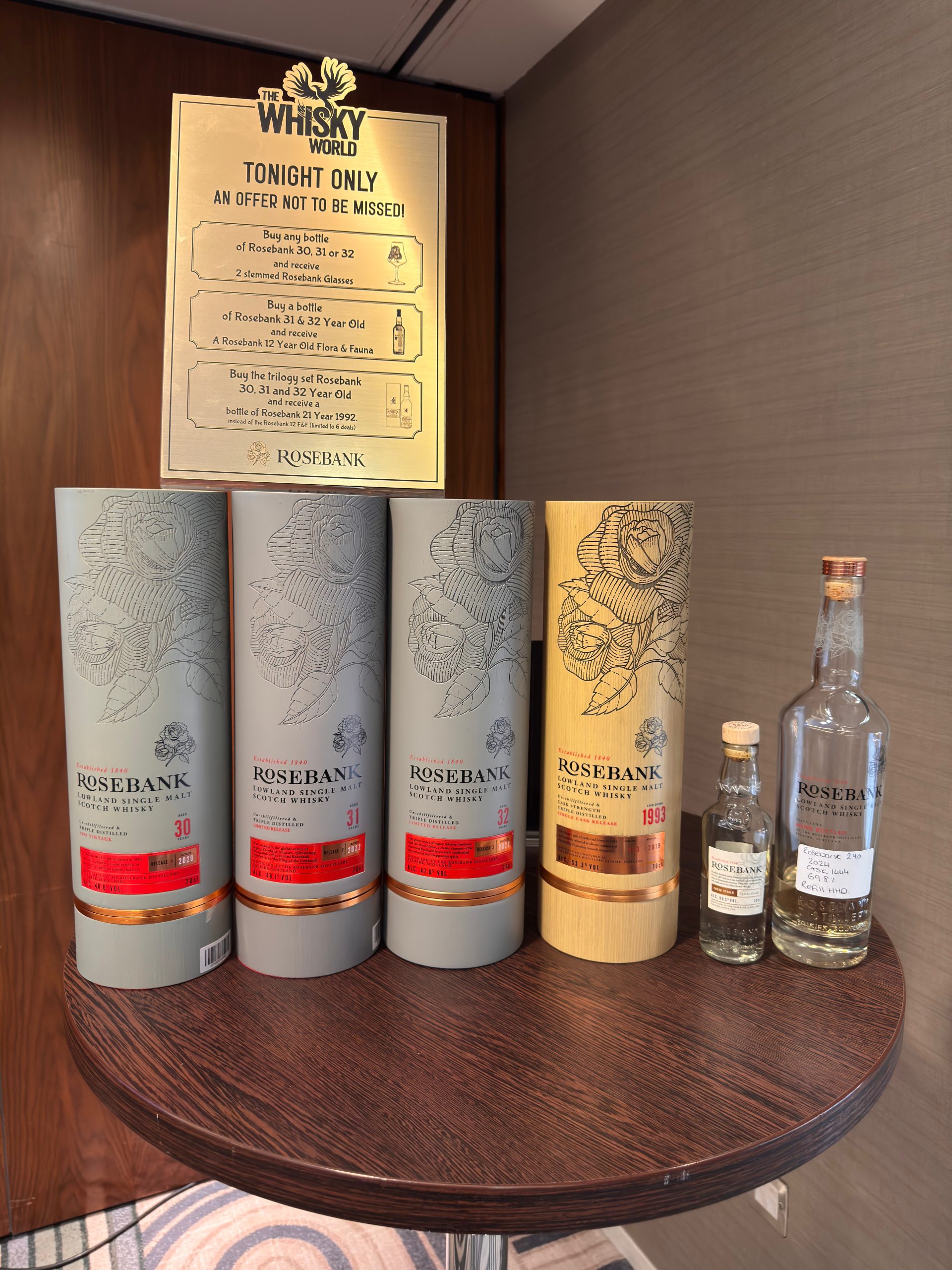
There is something special about tasting whisky from a distillery that had been closed down. And something even rarer about sitting with Gordon Dundas, Brand Development & Advocacy Director for Rosebank, and hearing the story of how one of Scotland’s most beloved Lowland distilleries went from closed and forgotten to distilling again.
That was exactly the experience we had at this year’s masterclass at The Whisky Event in London.

Diageo, Flora & Fauna, and a quiet farewell
Rosebank closed in 1993. Diageo owned the distillery and chose to halt production, as they did with many other distilleries during that period. Whisky enthusiasts will recognise the expressions from that era through the Flora & Fauna series, Diageo’s canonical, understated release with its botanical label and an information panel that was rarely particularly generous with detail.
What lay inside the casks, however, was anything but understated.
The distillery stood empty for decades. Not because the whisky was poor, quite the opposite. Rosebank had always been spoken of as the Lowlands’ answer to the finest Speyside had to offer: light, floral, complex. The problem was simply timing and priorities within a large corporation.
Ian Macleod Distillers takes over and rebuilds from scratch
In 2017, Ian Macleod Distillers purchased the distillery. And they did not approach the task lightly.
Gordon walked us through the process of rebuilding Rosebank from the ground up. This was not a renovation. It was a reconstruction. New equipment, new stills, but with full respect for the historical production method, including triple distillation, which is one of the key reasons behind Rosebank’s characteristic lightness and purity.
Today you can visit the distillery in Falkirk, see everything up close and taste new make spirit straight from the source. Gordon described the experience with an enthusiasm that was hard not to be swept up in.
Four whiskies from an era that will not return
The masterclass offered four expressions from the original Rosebank. Expressions of which very few bottles remain in the world.

Rosebank 30 Year Old. This is where it starts. Thirty years in oak, and still carrying that signature Rosebank lightness. Flowers, citrus, a delicacy that serves as a reminder that more time in cask does not always mean a heavier whisky.
Rosebank 31 Year Old. A touch more dried fruit, slightly more complexity on the finish. The differences between these three vintages are subtle, but they are there.
Rosebank 32 Year Old. The oldest of the three, and still not overwhelmed by oak. It is impressive how clearly the distillate’s character holds its own after so many years.
Single Cask, Distillery Exclusive, Cask No. 433, 1993. This is where you hold your breath. 1993 is the year of closure. This cask is from the very last production year of the original Rosebank. Fruity, intense, with a depth that makes sense for every year it has spent maturing. And it is only available at the distillery.
New make and two year old spirit: The whisky of the future
Perhaps the most remarkable part of the masterclass was the opportunity to taste the future.
Ian Macleod’s Rosebank new make spirit is bright, fruity, carrying that characteristic purity from triple distillation. And the two year old spirit from the new distillery is already a promise of something great. Fruity and exciting, with a structure that points clearly forward.
Gordon was diplomatic when we asked when the first official whisky from the new Rosebank would reach the market. The answer hung in the air. For a distillery that has waited this long, and with a legacy that weighs on the product in the best possible way, it seems unlikely they will rush. Our best guess: we probably will not see an official release for another seven to nine years, at minimum. What is currently in the casks is three years old at most.
But that is the right call. Rosebank should not be hurried.

A thank you to Gordon Dundas
The masterclass would not have been the same without Gordon’s ability to convey both history and passion. It is rare to meet someone who can sit with a glass of 32 year old whisky and still speak about the future with the same enthusiasm.
Rosebank is not just a distillery that has been revived. It is one of those whisky stories that reminds you why we drink this stuff in the first place: because time, craft, and patience mean something.
We look forward to following the journey from here.

The masterclass was held at The Whisky Event in London as part of the event’s exclusive programme.
Leave a Reply