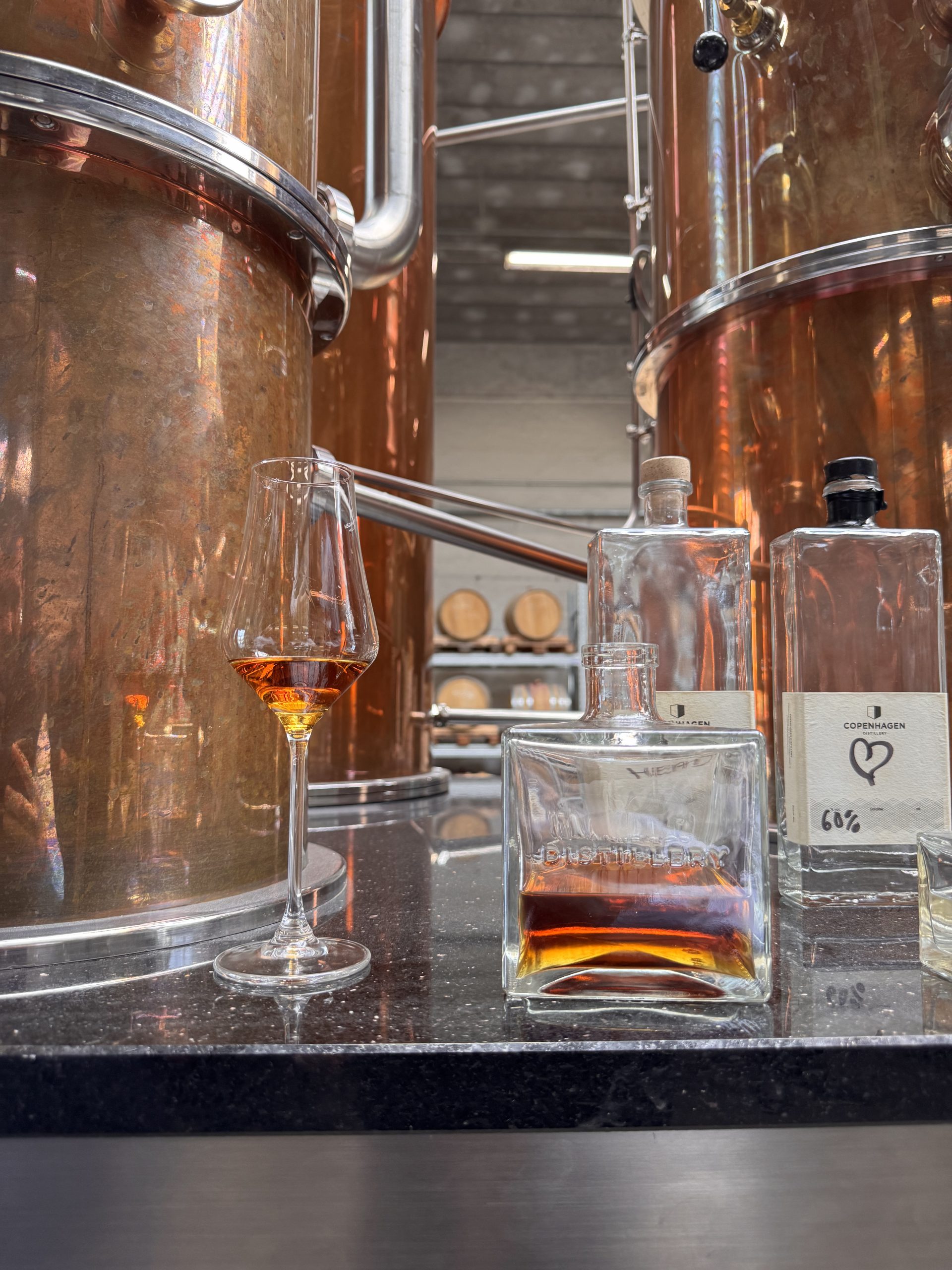
Sitting at Copenhagen Distillery, tasting the same whisky at cask strength, then two percent lower, then two percent lower again, all the way down to twenty percent, teaches you something no label ever will. We were there to help choose the bottling strength, and by the time we reached the bottom of the range the whisky had become a different drink. Same spirit, same cask, same glass. The number was the only thing we changed, and it changed everything.

That is the thing to understand about whisky ABV. The figure on the bottle is a decision someone made, not a mark of quality. Learning to read it, and learning when to overrule it with a few drops of water, is one of the quickest ways to get more out of every dram you own.
What whisky ABV and proof actually mean
ABV stands for alcohol by volume. It is the share of the liquid in the bottle that is pure alcohol, written as a percentage. A whisky at 46% ABV is 46% alcohol and 54% water and flavour compounds. This is the standard used across Europe and most of the world.
Proof is the older system, still printed on American whiskey. In the US, proof is simply double the ABV. A bourbon at 40% ABV is 80 proof, a 46% whiskey is 92 proof, and a 60% cask strength release is 120 proof. If you ever see a number that looks twice as high as it should, that is proof talking, and you can halve it to get back to ABV.
There is one legal line that every whisky has to clear. To be sold as whisky it must be bottled at a minimum of 40% ABV. Go below that and, by law, it is no longer whisky. That 40% floor is where a great many bottles sit, and there are good reasons for it.
Whisky strength at a glance
| ABV | US proof | What it usually signals |
|---|---|---|
| 40% | 80 | The legal minimum. Approachable, widely available, built for a broad audience |
| 43% | 86 | A common step up, often used for travel retail and export bottlings |
| 46% | 92 | The modern craft threshold, frequently paired with non-chill filtration for more texture |
| 50 to 65% | 100 to 130 | Cask strength. Bottled at the strength it left the cask, water optional and in your hands |
Why 40%, and why 46% has become the modern choice
A lot of distilleries bottle at 40%. It stretches a cask further, it lands softly for newcomers, and at its best it delivers a clean, open expression that needs nothing added. There is real craft in balancing a whisky to sing at 40%, and some of the most loved drams in the world live right there.
A more modern approach has grown up alongside it, and that is bottling at 46%. The extra strength is not about power for its own sake. It is about holding on to flavour and texture that can otherwise be lost, and it opens the door to non-chill filtration.
Here is the connection worth knowing. When whisky is chilled or watered down, natural oils and fatty compounds can turn it hazy. Producers often chill filter to remove them and keep the liquid bright. Those same compounds carry texture and flavour, though. Above roughly 46% the haze does not form in the same way, so a distillery can leave the whisky non-chill filtered and keep everything in. That is why 46% and non-chill filtered so often appear on the same label. The strength is doing quiet work behind the scenes.

The point most people miss: strength is not quality
We have poured a lot of cask strength whisky at tastings, and one lesson comes up again and again. A big number does not guarantee a big experience, and a small number does not guarantee a gentle one.

We have opened whiskies in the mid fifties that carried real power, the kind that grips the whole mouth. We have opened others at the same strength that were mild and rounded, where the alcohol sat back and let the aromas lead. The ABV was identical. The difference was the spirit and the cask.
This is why you can meet a whisky at 60% that feels more composed than a poorly made one at 46%. When the spirit is clean and the cask has done its job, the alcohol integrates into the whole rather than standing in front of it. When it has not, no amount of strength or dilution hides it. High ABV can flatter a good whisky and expose a weak one in equal measure, which is also why chasing strength for its own sake is a mistake. It is one tool among many, not a scoreboard.
What high ABV does in the glass, and in the mouth
A higher strength gives you more to work with. There is more pressure and more drive across the palate, a sense of the whisky arriving with intent rather than politely. For a lot of drinkers that intensity is the appeal, and it is genuinely enjoyable when the whisky can carry it.
It also hands you control. This is the real argument for buying at higher strength. You can always add water. You cannot take it away. A cask strength bottle is effectively several whiskies in one, because you get to choose where on the scale you drink it, glass by glass.
Adding water: what it does and why it works
Adding a drop or two of water is one of our favourite things to do at a tasting, and it is not a party trick. The aromas genuinely open up. Texture shifts, the nose changes, and notes that were hidden under the alcohol come forward on the palate.
There is science behind this. A 2017 study in the journal Scientific Reports, by Karlsson and Friedman at Linnaeus University, modelled what happens to guaiacol, one of the compounds behind smoky, savoury flavour. They found that below around 45% ABV the compound gathers near the surface of the liquid, exactly where your nose and mouth meet it. At 59% and above it gets pulled down into the body of the drink, away from where you taste it. In other words, easing the strength down brings the flavour up to the surface. It is a neat explanation for something whisky drinkers have felt for generations.
This is also why master distillers assess new make and maturing stock at very low strengths, sometimes taking it right down to 15 to 20% ABV. At that level the aromatics are laid bare, and it becomes far easier to judge what the spirit is actually doing.
You do not need to go that far in the glass. Start with a single drop, nose it, add another, and stop the moment it sings. How we taste is individual, so there is no universal ratio. The whiskies that reward this most tend to be the higher strength ones, where there is room to move. A cask strength release will often transform with water, softening its grip and unfolding its layers. A well balanced 40% frequently needs nothing at all, because it is already sitting where the maker wanted it.
So is there a best ABV?
No, and that is the honest answer. The best strength is the one that suits the whisky in front of you and the mood you are in.
If we had to give practical guidance, it would be this. Buy the higher strength when you can, because it gives you range. Treat 46% and non-chill filtered as a strong sign that texture has been protected. Trust a good 40% to deliver exactly what its maker intended, poured neat. And keep a small jug of water within reach, because the most interesting whisky of the night is often the one you meet three times at three different strengths.
The number on the label starts the conversation. What you do next is up to you.
FAQ
What does ABV mean on a whisky bottle? ABV stands for alcohol by volume, the percentage of the liquid that is pure alcohol. A whisky at 46% ABV is 46% alcohol. To be legally sold as whisky it must be at least 40% ABV. It is the standard measure used across Europe and most of the world.
What is the difference between ABV and proof? ABV is the percentage of alcohol by volume, used in Europe and beyond. Proof is the older American system, and in the US it is simply double the ABV. So 40% ABV is 80 proof, 46% ABV is 92 proof, and a 60% cask strength whiskey is 120 proof. Halve the proof to get the ABV.
What is the minimum ABV for whisky? Whisky must be bottled at a minimum of 40% ABV to be legally sold as whisky. Below that strength it cannot use the name. Many bottles sit right at this 40% floor, which is approachable and widely available, while cask strength releases can reach 60% ABV or more.
Does whisky taste better with water? Often, yes, especially at higher strengths. Adding a few drops of water lowers the alcohol and brings aroma compounds to the surface of the liquid where you smell and taste them. Cask strength whiskies tend to open up noticeably. A balanced 40% whisky may need nothing. Start with one drop and add slowly.
What does cask strength mean? Cask strength whisky is bottled at the strength it comes out of the cask, with no water added to reduce it, usually between 50% and 65% ABV. It gives you the fullest version of the whisky and lets you dilute it yourself to whatever level you prefer, glass by glass.
Is higher ABV whisky better? Not automatically. Strength is not the same as quality. A well made whisky at 60% can feel more composed than a weak one at 46%, and a great whisky at 40% needs nothing added. Higher ABV gives you intensity and the freedom to add water, but the spirit and cask decide how good it is.

Leave a Reply